
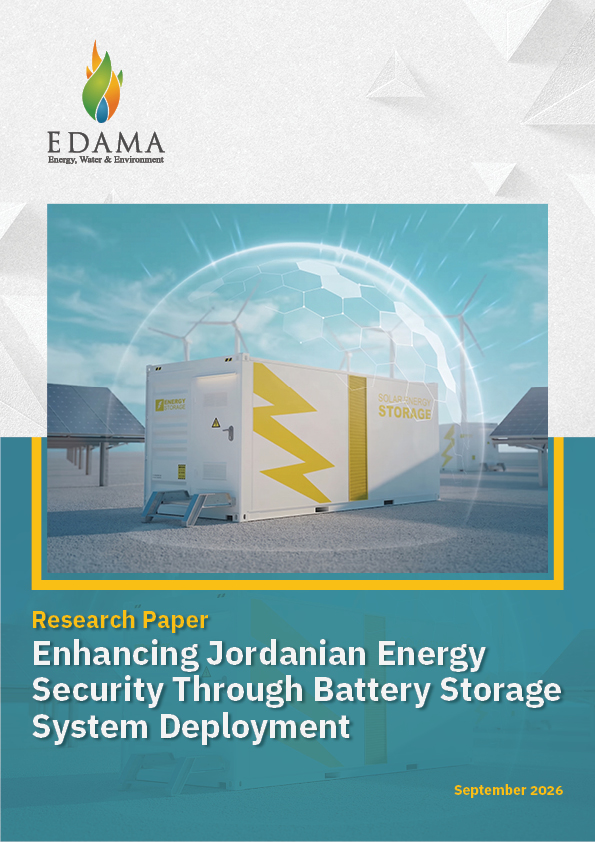
EDAMA Association for Energy, Water & Environment has released a research paper titled “Enhancing Jordanian Energy Security Through Battery Storage System Deployment.” The paper examines how battery energy storage systems can strengthen the Kingdom’s energy security. This matters more as renewable energy’s share of the electricity mix grows and as Jordan continues to depend on imported natural gas.
The paper traces how energy storage developed in Jordanian law, from the Renewable Energy and Energy Efficiency Law No. 13 of 2012 to the Electricity Law of 2025. It identifies the main challenges facing the sector, including the absence of a dedicated regulatory framework, residential capacity limits that restrict battery sizing, an undefined tariff structure for combined renewable and storage systems, gaps in grid readiness, and limited financial incentives. In response, it proposes four practical approaches. These are developing a comprehensive regulatory framework for storage, upgrading grid infrastructure, adopting flexible battery sizing provisions, and introducing targeted financial incentives informed by international models such as Australia’s Cheaper Home Batteries Program.
These recommendations aim to enhance grid stability, make fuller use of Jordan’s renewable energy resources, and strengthen long-term energy security. They also support Jordan’s role in the region’s clean energy transition.